Kuem´s story
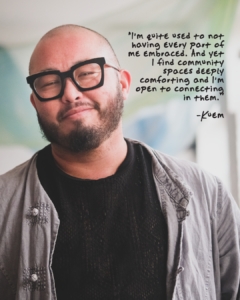 What does community mean to you?
Community is a space where I feel seen and safe enough to explore and to be myself. I have a lot of intersections – I’m a trans person, a fat person, a person of colour, with German and Korean roots – and there aren’t many spaces where I feel completely seen in all of those parts at once. I’m quite used to not having every part of me embraced. And yet I find community spaces deeply comforting and I’m open to connecting in them. When something feels off, I’m also quick to leave spaces where I don’t feel welcomed or at home. But when it’s right, it really matters.
How do you find your community?
I follow my gut and the people I know. It’s often through personal recommendations – a friend saying, ‘this place is amazing, it could be a fit for you, let’s go.’ So a lot of it comes through personal connections. As a facilitator, I also create community myself – I try to take bits and pieces from other gatherings and spaces and bring them together to create environments where people feel welcome and comfortable. I know how tricky that is, how many angles you have to hold in mind. But it’s something I’m deeply committed to.
How do you celebrate yourself and your community?
Celebration, for me, is a lot about visibility. Being unapologetically present, in the open, in public — taking up space. Not hiding, not glossing over things, not washing over who I am. Being proud of who I am and representing that. That’s my personal celebration. And in community, celebration is about getting together and feeling the joy of being alive and being there — often through food. I organise a Lunar New Year retreat for queer BIPOC people, and we always cook and eat a lot together. Food connects us to our roots, to our ancestry, to each other. It’s a real form of celebration.
What do you think makes this project unique?
It’s very open, and it combines things that are very dear to my heart – body work, tenderness, and openness to all sorts of gender expression. That’s quite different from a lot of mainstream gay spaces. Of course, like any space, it’s also a mirror of society – we all bring our prejudices and upbringings with us. But what I think is unique is the continuous, committed effort to learn and to develop. When I first stepped into Village, I felt at ease and comfortable in a way that felt significant, especially as a trans person of colour. I know that’s not everyone’s experience, and I know that for some trans people there were hard times in the earlier years that led them to stop coming. The road was paved before I arrived, and there were heartbreaks along the way. I’m very grateful to be at a point now where I feel good being in the Village.
Can you share a moment at We Are Village or Stretch that felt meaningful or stayed with you?
As a facilitator, some of my most memorable moments have been leading workshops at Stretch – I’ve had sessions with over seventy people engaging fully throughout. Those are etched into my brain. But the moment that feels most meaningful in the context of community was my very first Stretch as a participant. I walked into the room and was completely overwhelmed. I spotted a friend – a trans person I knew who was also a body worker – but they were in conversation with someone else. So I just stood there, back to back with them, and quietly took their hand. Just trying to catch my breath, to land. After a minute I was okay – I could go into the room, mingle, find other friends. But that small moment, that quiet ‘I’ve got your back’ – that was such a pure community thing. I still get emotional thinking about it.