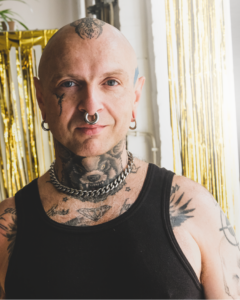
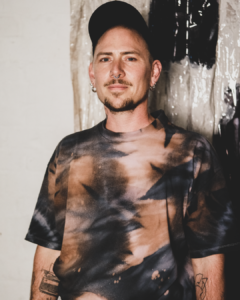
Niolaj´s story
What does community mean to you?
That’s a difficult question that people have lots of different ideas about. I don’t think I have one single idea of what community means. Sometimes people have a very high bar for it – that anything short of a chosen family isn’t real community – which would be great if we all had that, but it’s often not the case. And sometimes we set standards for community that feel almost impossible to reach. I think it makes more sense to think of community as a scale – from more to less tight – rather than a fixed definition. For me it starts already with growing up queer: feeling different and outside the norm, finding it hard to fit in, and then suddenly finding people who are also all different – and the things that made you different from others growing up are now the things you actually have in common with people. That’s already the first layer of community for me. And then it goes all the way up to a chosen family of people who support you the way we assume biological family does. So it’s more like different layers along a scale than one single thing.
How do you find your community?
I don’t have one way of finding it. In the past it happened a lot through nightlife and partying – not just clubbing, but also culture and things that often revolved around night life, like music and performance. There was always a cultural dimension to it. Then came the pandemic, and the network I had – which was large but not very close – suddenly crumbled during the isolation. So I had to rethink. Now I still tend to use cultural interests and mutual interests as a way into wider community. Going somewhere like Stretch, for instance, where everyone arrives with shared intentions – that creates a strong feeling of community, of having a shared experience that feels meaningful and speaks to you.
How do you celebrate your community and yourself?
I would say with love – in the bell hooks sense of love as an action: doing things that nurture yourself and others. The more spiritual aspect isn’t really my thing, but the idea of doing things that nurture yourself, others, and the community – that feels right to me.
Can you give an example of that?
Doing somatic workshops, for instance – that’s something where you make yourself and everyone present feel good, and give yourself and others a gift that you also take out into the world, spreading awareness, presence, and quality of being. Something like the Gay Consent Lab is also a space that does very meaningful work – getting together and talking about consent in the community, how it works in practice, and how we become better at it. I think that’s also a kind of love toward yourself and the community.
What do you think makes this project unique?
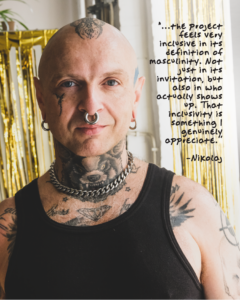
There aren’t many spaces that are focused on the broader queer male spectrum of masculinity, that aren’t party spaces, commercial spaces, or sex spaces, but are instead focused on nurturing exchange, whether through talk, reflection, or somatic and bodily work. There are more spaces like that in femme-oriented contexts, but not so many focused on the male end of the spectrum in that same way. I also really appreciate that – especially at Stretch, but also more broadly – we are village feels very inclusive in its definition of masculinity. Not just in its invitation, but also in who actually shows up. That inclusivity is something I genuinely appreciate.
Can you share a moment that has been meaningful to you or stayed with you – from Stretch, a workshop, or anything related to the project?
It’s hard to pinpoint a single moment. But one that comes to mind is when we first started the training this year. I was a little nervous, because even though I know it shouldn’t be the case, I often don’t feel fully comfortable or at home in all-male spaces – even in gay male spaces. So I arrived feeling a little alienated, a little outside. Then we had a heart circle, and I spoke about that feeling. Afterwards, so many people came up to me and said ‘thank you for saying that’, because they really related to what I was saying. That was really moving, because usually you just look at people and make assumptions, and you don’t get to know how many others actually feel strange or awkward about being there. Once you start opening up, you realise you have more in common with people than you thought.