Minu´s story
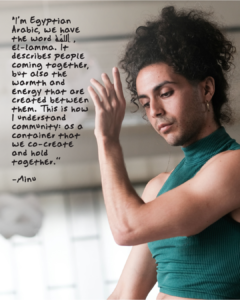 What does community mean to you?
I’m Egyptian Arabic, we have the word اللَمّة, el-lamma. It describes people coming together, but also the warmth and energy that are created between them. This is how I understand community: as a container that we co-create and hold together.
Within this container, mutual care, exchange, and support become possible. It is a space where we can listen and be listened to, resonate heart to heart, inspire one another, and remain playful and curious. We can exchange energies and go on a shared journey of research and discovery, while each person brings their own presence and experience.
For me, community is not simply a group we belong to. It is something we continuously practise through rituals of care, trust, attention, and showing up for one another.
How do you find your community?
I find my community through a kind of magnetism. I feel drawn towards certain people, spaces, and energies, both virtually and in physical spaces. Often, there is a sense of recognition before there is even a name for what connects us.
Sometimes I enter communities that already exist, and sometimes a community quietly forms around something we create together. With proximity, our energies begin to amplify one another. We show up, create opportunities for each other, and invest our time, attention, and care in one another’s journeys.
For me, finding community feels less like searching for a place where I fit and more like following resonance. The magnetism brings us together, but it is reciprocity that turns the encounter into community.
How do you celebrate yourself and your community?
I celebrate my community by being its biggest fan: cheering for people, fanning their fire, and showing up for the occasions where they flourish. Whenever possible, I try to make my care bodily: to be there in the room, offering not only words but my physical presence and warm hugs. With close friends, my love language is often cooking and sharing food. I also celebrate through listening, bellydance, drag, and movement workshops, creating moments of joy, expression, and resonance. I celebrate myself by allowing myself the same things: to be nourished, playful, expressive, and fully seen.
What do you think makes this project unique?
What makes these projects unique to me is that they do not treat community simply as an audience, but as a source of knowledge, practice, and lived experience.
Through Queer Bridges, I facilitated a workshop within a platform that amplifies migrant and BIPOC voices, creating space for embodied and cultural knowledge that is not always explored within mainstream Western cultural spaces.
At Stretch Festival, I experienced a community gathering unapologetically around pleasure, sensation, intimacy, playfulness, and shame. It opened space for forms of connection and expression that cannot always be understood through heteronormative or binary frameworks. It felt liberating both to share my practice and to receive the practices of other community builders.
At Instinct’s UNVERSCHÄMT! exhibition, I explored themes of shame through my performance art piece SELF, bringing my own lived experience and embodied perspective into dialogue with the audience and the surrounding artworks.
For me, the uniqueness lies in this reciprocity: The Village creates and holds the container, while artists, facilitators, and community members bring their own experiences into it and continuously reshape it together.
Can you share a moment at we are village or Stretch that felt meaningful or stayed with you?
One moment that has stayed with me was participating in Peter Pleyer’s Slow Motion Love Rave at Stretch. Inspired by Authentic Movement, we moved extremely slowly through the space with closed eyes. Bodies met, melted, shaped, and flowed together. It felt angelic, effortless, and euphoric.
For a moment, relating existed beyond familiar social codes and expectations. It became a process of unlearning how bodies are supposed to meet and allowing ourselves to navigate, approach, withdraw, and explore. Community was not something spoken about or organised; it was something we sensed and created through movement.