Baptiste´s story
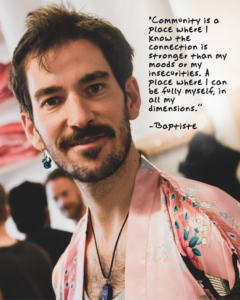
What does community mean to you?
The first thing that comes to mind is bonds between people that I can rely on – bonds that hold regardless of whether I’m happy or struggling, easygoing or being difficult. Community is a place where I know the connection is stronger than my moods or my insecurities. A place where I can be fully myself, in all my dimensions.
How do you find your community?
For me it first happened through tantra. When I started practising, about twelve or thirteen years ago, we formed a group of friends who have remained friends ever since. The depth of what we shared created such a strong bond – they can welcome all parts of me. Then it’s been through activities more broadly. I have a group of friends I originally met through tantra, who became very close over time, partly through the conversations we had on very intimate and taboo topics – talking about sexuality in specific and concrete terms, things we don’t usually get to speak about in other circles. That shared vulnerability created a bond where we can really be ourselves, including the more hidden or shameful parts. On a lighter note, community also starts with activities – like the queer tango scene, which is a looser community for me, but still a very enjoyable one. Activities create regularity and practice together, and so many opportunities for connection – talking between two dances, for example. And if it’s just small talk with no vulnerability, it doesn’t go very far.
How do you celebrate yourself and your community?
When something goes well, I like to share it with my friends so we can celebrate together. That’s how I celebrate achievements – by bringing them to my community. And I celebrate my community by telling the people in it that I love them, regularly. Just honouring and making it explicit: thank you for being in my life, this is so valuable. It’s a simple thing, but I think it nourishes the community. We often take it for granted, but saying it out loud is powerful.
What do you think makes this project unique?
The first thing is what I mentioned earlier – it’s a queer space centred, at least partially, around somatic and body-based work. I’ve never seen that anywhere else. There are LGBTQIA+ centres in many cities, but they tend to offer information and meeting points rather than spaces where things actually happen. And many queer organisations rent spaces temporarily for their activities – it’s always ephemeral. Village is there. It’s a permanent queer space you can go to whenever you need it. That stability is something really secure and rare. You can look up whatever activity is on and just go. A permanent physical queer space where you can simply hang out – that’s quite unique.
Can you share a moment at we are village or Stretch that felt meaningful or stayed with you?
There are many, but two stand out. The first was as a facilitator, last summer, when at the end of a Stretch festival one of the participants came up to me and thanked me – and then said: ‘Actually, thank you for the workshop last year too, because I realise now, with perspective, that it was through that workshop that I started loving myself.’ I was deeply touched. The fact that Village creates spaces where something like that can happen – that stayed with me. The second is more general: the people I’ve met there. The connections. It’s very rare to find queer people who are also deeply involved in body work and somatics. In France, there’s a lot of activism, a lot happening – but not so much grounded in the body. The people I meet at Village are genuinely fascinating, and those connections are ones I long for.